Frequently asked questions
File search
What file formats does Gety support for search?
Gety focuses on documents you read and refer to, such as Word documents, slides, PDFs, and notes.
System files and source code are outside this scope; use a dedicated tool to search them.
Currently, Gety supports the following local file formats:
- Text (
.txt) - Markdown (
.md) - PDF (
.pdf) - Word (
.docx,.doc) - Excel (
.xlsx,.xls) - PowerPoint (
.pptx,.ppt) - WPS (
.wps) - HTML (
.html,.htm) - Image (
.avif,.bmp,.gif,.jpeg,.jpg,.png,.tif,.tiff,.webp)
Review or change the indexed formats in Settings → Local Files → File Types.
In the future, we plan to support more formats.
Will indexing all my files take a long time?
Yes. Indexing your whole computer for the first time takes time, especially when processing text in images and building the semantic index. The time needed depends on your files and computer's performance.
Although initial indexing can take a while, we recommend including supported documents across your whole computer. Many users report that Gety helped them find files they had previously been unable to locate.
Files are often scattered across your Desktop, Downloads, and folders for current and past projects. Indexing all these locations lets you search without remembering where a file is saved or gathering everything into one folder. Connected AI tools can also find relevant material beyond the current project.
Gety uses adaptive scheduling and indexing optimizations to reduce the impact of initial indexing on your everyday work. Choose the mode that suits your needs:
- Automatic scheduling (default): Gety adjusts indexing speed based on CPU usage, whether your computer is plugged in, and other conditions. It slows down when your computer is busy and speeds up when it is idle.
- Full speed: Finish indexing at full speed. Use this mode overnight or whenever you are away from your computer.
- Paused: Pause for an hour, for the rest of the day, or until you choose to resume.
Files that have already been indexed remain searchable in every mode. After initial indexing, Gety processes only new, modified, and deleted files without indexing your whole computer again.
Hardware acceleration can also help: on compatible Windows computers, Gety supports CUDA acceleration and Intel NPU acceleration. Apple silicon Macs running macOS 13 or later use hardware acceleration automatically. See system requirements for hardware requirements and CUDA setup.
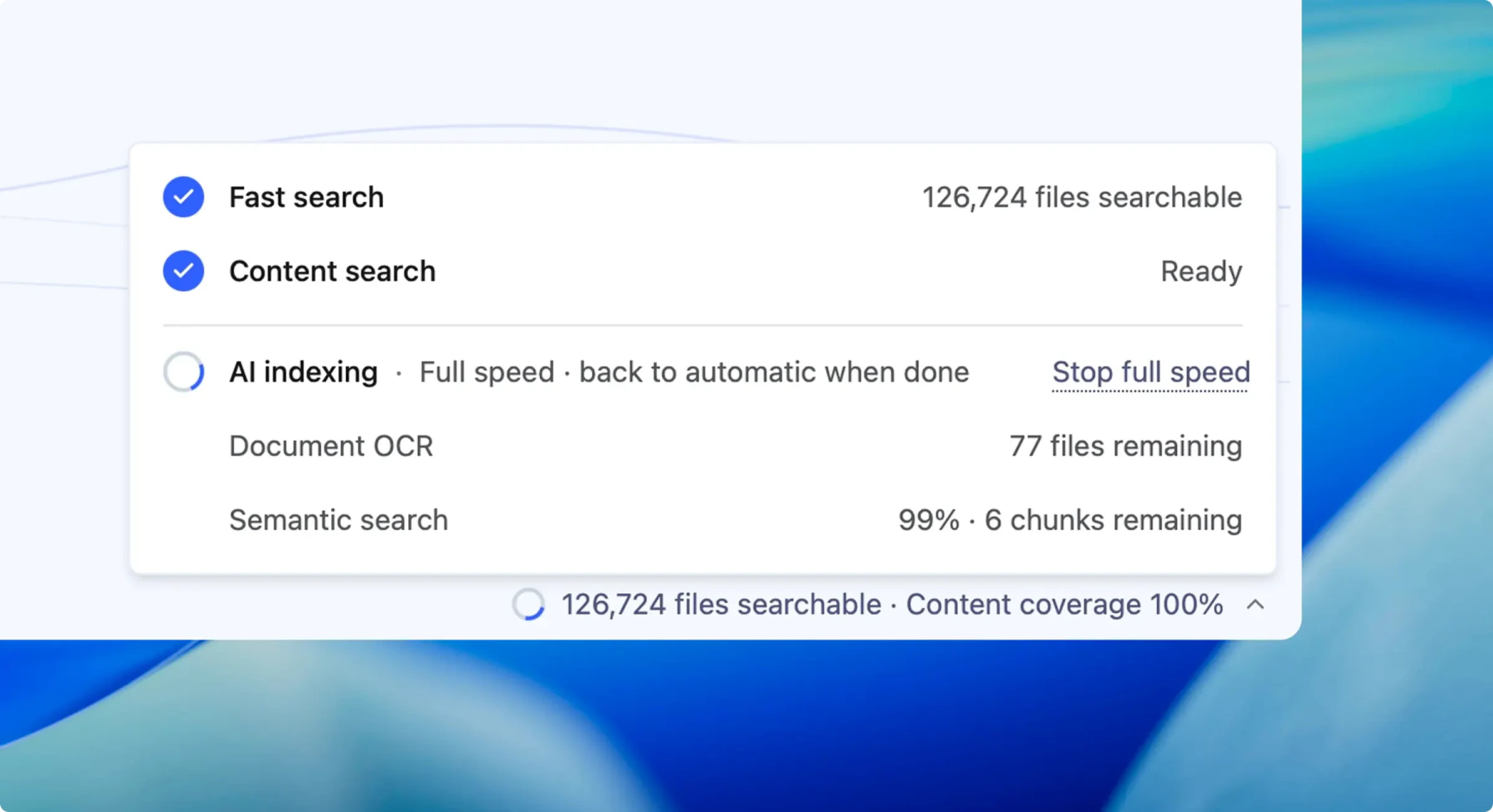
Click the indexing status in the lower-right corner to see how many files are searchable and how much indexing remains. The panel below shows AI indexing running at full speed.
Can I search before indexing finishes?
Yes. You can start searching right away without waiting for indexing to finish.
- Fast indexing: File titles become searchable within about a minute.
- Content search: Gety extracts file content in the background. You can search the parts that have already been processed at any time.
- Document OCR: Text recognition takes a little longer, but you can search the parts that have already been processed at any time.
- Semantic search: Even before the semantic index is complete, you can search files that have already been processed.
Does the index update in real time when files change?
Yes. Gety monitors your files in real time and automatically updates the index whenever it detects a file being added, modified, or deleted.
This keeps your index up to date without you having to refresh or rebuild it manually.
What are Gety's key search capabilities?
- Index your whole computer: Gety can index supported documents across your computer, with search results typically returned in under 1 second once indexed. Gety also optimizes initial indexing to help you get started sooner.
- Connectors: Beyond your local files, you can connect sources such as Notion to search your pages in Gety. See connectors for available options and setup instructions.
- File preview: Quickly preview content without opening the file.
- Jump to relevant passages: Open the preview to jump automatically to the passage you need.
- Precise filtering: Quickly filter results by file type, modification time, match type, and other criteria.
- Smart sorting: Sort intelligently by relevance or update time, keeping the files you need most at the top.
What are some search tips for using Gety?
Use these search methods and filters to find the files you need:
- Keyword search: Simply enter keywords. Gety quickly scans the full content of files and returns results instantly.
- Filter with
@: Type@in the search box. Choose a file type, folder, connector, time range, or match type, and combine filters to narrow your search. - Semantic search: Even if you don't remember the exact words, Gety understands your intent. Searching for "contract" might find files containing "agreement" or "statement of work".
- Exact search: Turn on Exact Match in the left filter panel to treat your entire query as one phrase. To keep only part of a query together, wrap those words in double quotes, for example
contract "product design". - Use the left filter panel: Click the filter icon to adjust filters in the left panel. These selections stay in sync with filters added using
@.
How much disk space does the index use?
Index size varies widely, mainly depending on how much text your files contain, rather than just their format or file size.
For example, high- and low-resolution PDFs of the same document can have very different file sizes. If Gety extracts the same text from both, their text indexes take up the same amount of space.
Regardless of file type, Gety's index is far smaller than the original files.
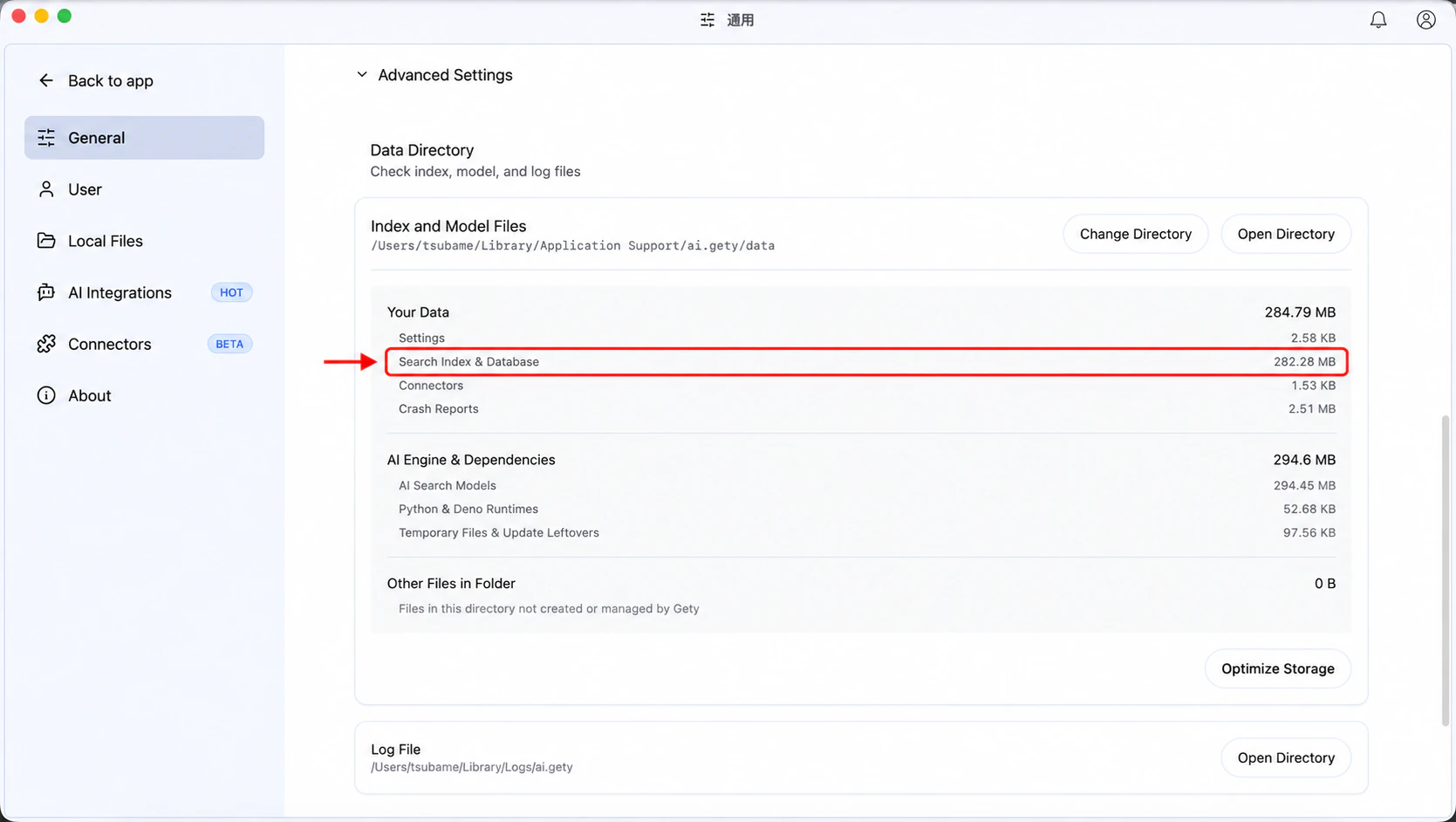
To check actual usage, open Settings → General → Advanced Settings → Data Directory and find Search Index & Database under Your Data. AI models and runtimes are listed separately under AI Engine & Dependencies.
Can I move Gety's data to another disk?
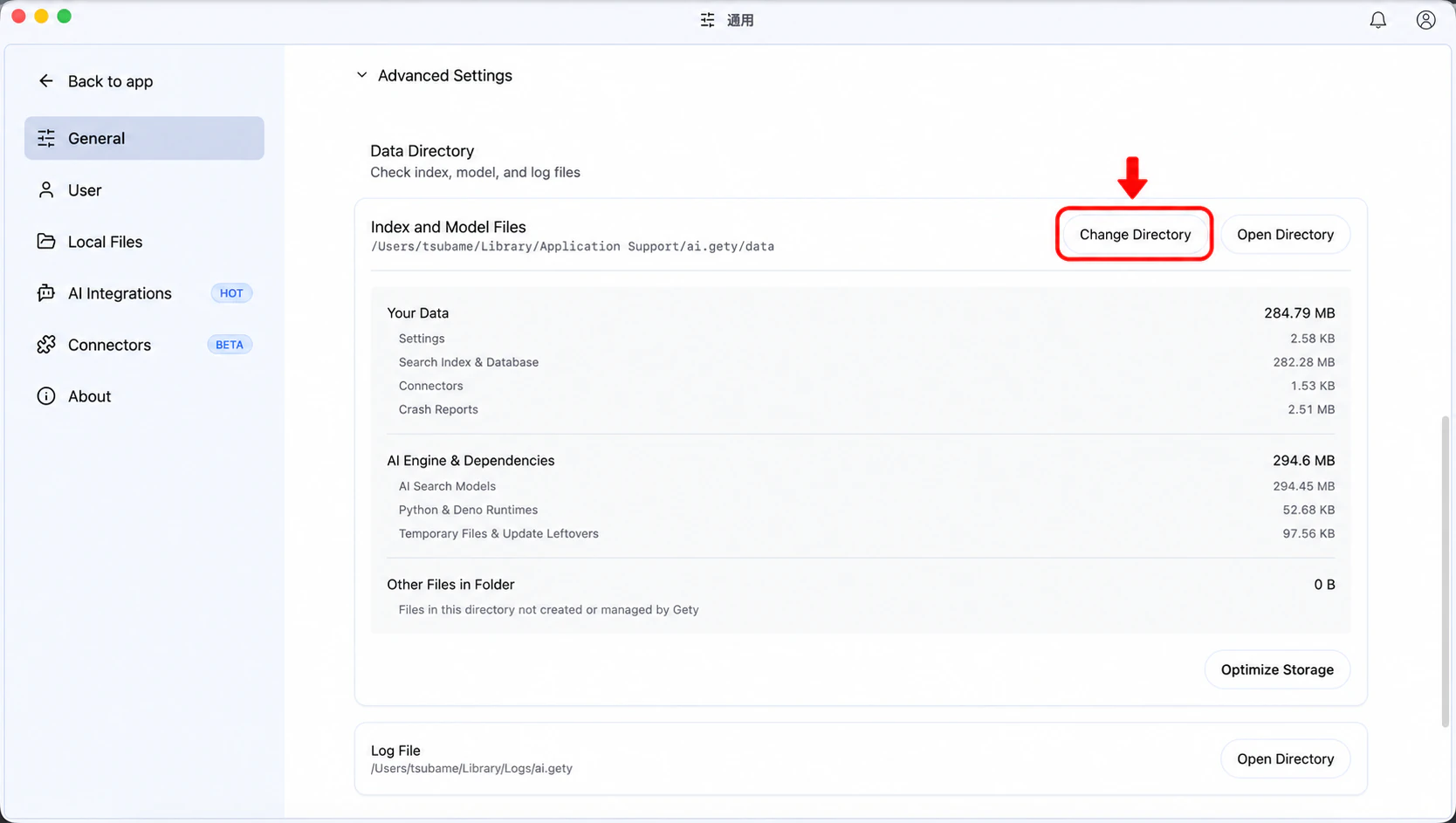
Yes. Open Settings → General → Advanced Settings → Data Directory to view or change the storage location. Use Gety's built-in migration process; do not move the directory manually.
You can also run Optimize Storage to reclaim unused space.
Data Directory shows index and model storage usage separately and provides controls to change the directory and optimize storage.
The index depends on the files and configuration on your current computer. You cannot copy it directly to another computer and reuse it there.
Will an update or reinstall rebuild my index?
Updates and reinstalls preserve your index as long as you keep Gety’s data. When uninstalling, leave the option to clear Gety data unchecked.
Installing on another computer, deleting the data directory, or uninstalling and clearing app data requires a new index.
Can Gety search local files offline?
Yes. Gety searches and indexes local files offline. OCR and semantic search use local AI models that need to be downloaded once. After downloading them, you can use these features offline too.
If you cannot download the models, OCR and semantic search are unavailable, but you can still search file names and text already present in documents.
On Windows, Gety also needs WebView2 to run. If it is missing, download and install it first. Optional hardware acceleration components also need to be downloaded before use. See system requirements.
Cloud AI services and connector updates from online services still require an internet connection.
Account and plans
What is the difference between the Free plan and Pro?
The Free plan and Pro include the same features. They differ in usage limits: the Free plan has monthly limits on file searches and AI integration requests; Pro has no limits on either.
See Gety pricing for current plans.
What does "quota exceeded" mean?
You've reached the Free plan's monthly usage limit for that feature. Gety shows when your allowance resets.
You can use the feature again after the reset date shown in Gety, or upgrade to Pro for unlimited file search and AI integration.
How many devices can I use with one account?
A single Gety Pro license covers use on up to three devices that belong to you, whether you use them for work, at home, or on the go.
AI integration
What is AI integration for?
AI integration lets your AI tools access local files and use your private data to give more accurate, useful answers.
- Chatbot: Let an AI chatbot search and cite your local files directly. For example, ask “Find the budget allocation section in the project proposals” or “Summarize last month's meeting notes.” The AI retrieves information from your files instead of giving a generic answer from the web.
- Agent: Agents use the same private local information to carry out more complex tasks. For example, ask AI to conduct in-depth research, analyze several documents and produce a report, or help develop a litigation strategy based on your case files.
Gety brings together searchable content across your computer, so your AI tool is not limited to one folder. It can retrieve relevant information from indexed folders for multiple projects, past cases, and company documents without you gathering everything in one place.
Beyond local files, connectors bring in content such as Notion pages. AI can use this content alongside your local files to answer questions, saving you from finding and copying material across apps.
How do I use AI integration?
Open Settings → AI Integrations. Gety offers two ways for AI tools to access your local files:
- One-click integration: Choose your AI tool, such as Claude, Cherry Studio, or Cursor, and follow the built-in guide to complete setup.
- Manual setup: Use Model Context Protocol (MCP) to add Gety to your AI app so it can access your files. See the detailed setup guide.
After setup, keep Gety running in the background. You can then use an agent directly in your AI app to get answers based on your local files.
More help:
- Introduction: how AI uses your files
- Setup: connect Claude
- See it in action
- Example: create deliverables with Claude Cowork
How does Gety protect my privacy when using AI integration?
Gety provides multiple layers of privacy protection.
First, Gety shares only search result snippets by default. AI tools can request full document text when needed, so they usually receive small excerpts rather than complete files.
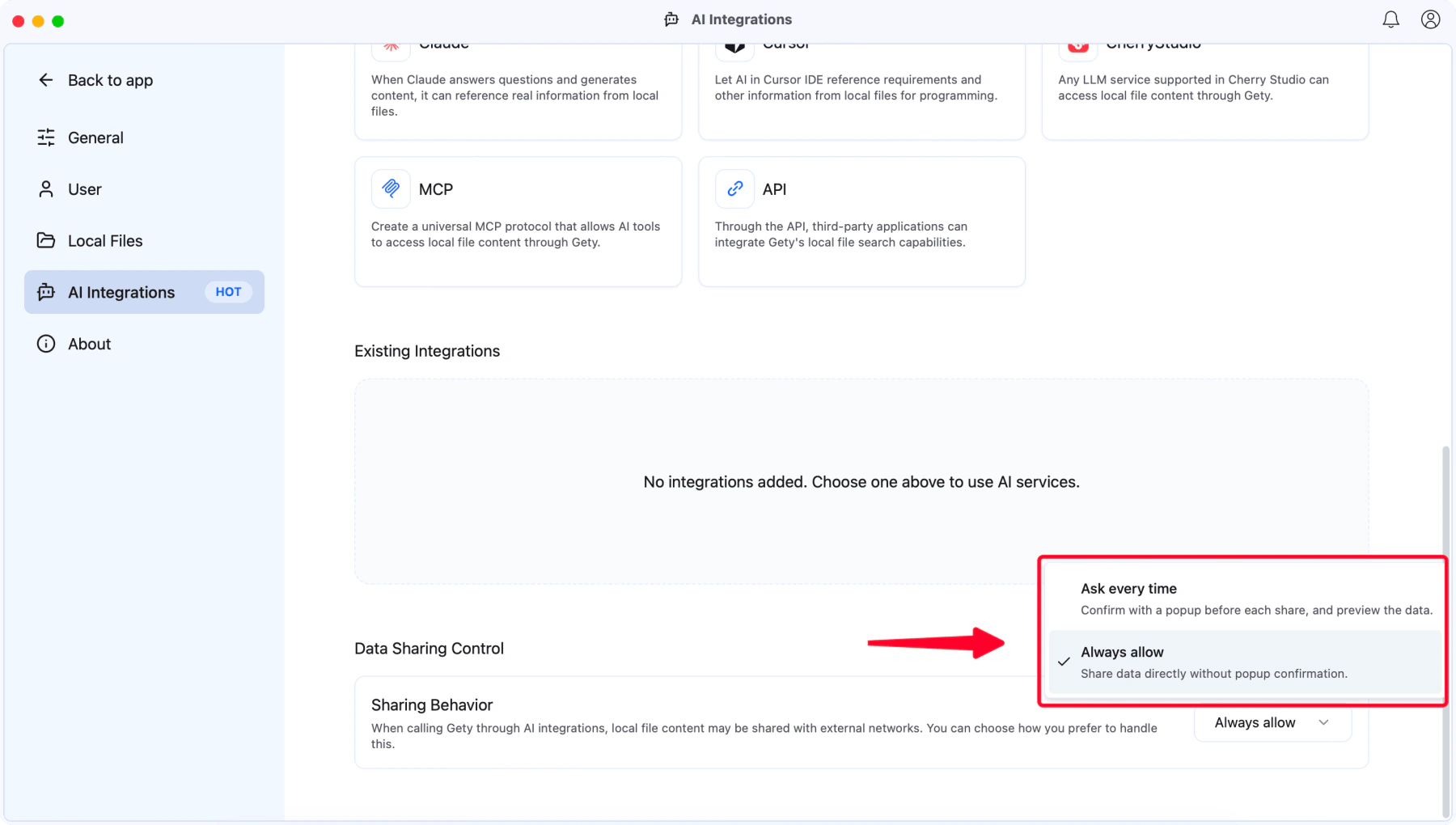
You can also control each sharing request through system notifications. Choose a mode in Settings → AI Integrations → Data Sharing Control:
- Ask every time: Review the data and confirm through a notification before each share. Keep Gety's system notification permission enabled.
- Always allow: Share data directly without notification-based confirmation.
Choose the mode you need under Sharing Behavior:
Gety indexes and searches files locally without uploading them to Gety's servers. When you connect a cloud AI service, the content you share is sent to that service and handled under its privacy policy. If you do not want material sent to the cloud, you can connect AI models and tools that run on your computer.
If notifications are disabled, restore sharing confirmations before using sensitive material.
Agents plan tasks and call tools autonomously. With file access, an agent may read material the user did not expect; when it uses a cloud model, that content may also be sent to the cloud. Users worry about which files the agent will read and which private details it might send.
Some users therefore use Gety as a “privacy gateway” between local files and an agent: the agent searches for relevant snippets through Gety, and the user reviews them before sharing, keeping control over which information is shared.
For example, when an agent analyzes a project budget, the user can allow the relevant budget passages while declining to share unrelated private content.
Which AI apps or models can I use Gety with?
You can use Gety in apps such as Claude / Claude Cowork, Claude Code, Codex, Cursor, Cherry Studio, and WorkBuddy. You can also connect local models through apps such as LM Studio.
What matters is whether your app can call Gety's search tools. Gety is not tied to a model provider. Your app needs MCP support or an integration through Gety's API or CLI, and your selected model needs to support tool calling.
Open Settings → AI Integrations, choose your app, and follow the built-in connection guide. If your app is not listed, see manual MCP setup.
Why use Gety if an agent can already search local files?
Gety helps agents search large file collections faster and find content in scans, while giving you control over what is shared.
-
Search large collections without making an agent read every file
Some agents search only the current project or folders you specify. Across years of projects, past cases, and company documents, you may have tens of thousands of files or hundreds of gigabytes of material.
Reading them one by one takes time and can fill the agent's context with irrelevant content. Gety indexes material across folders and connectors in advance, quickly finding relevant passages for the agent to use.
-
Extract text from images and scans before agents search
Even when an agent can recognize text in images, it typically does so after finding and opening a file, rather than running OCR on every file in advance. Text in images or scans may therefore be missing from its search.
Gety runs OCR on supported images and scans within your indexing scope and indexes the recognized text. Text in images and scans becomes searchable too, so relevant material is not excluded simply because it is stored as an image.
-
Share only what is needed to protect your privacy
You do not need to grant an agent direct access to large collections of private files. Let it search and filter through Gety to retrieve only the passages needed for the current task.
For example, a budget question may need only a few relevant paragraphs, keeping unrelated private material out of the agent's context. If you also allow the agent to read local files directly, it can bypass Gety to access them. Gety cannot control that access.
Can I ask questions about my files directly in Gety?
Gety does not currently generate answers or summaries from your files, and there are no plans to add this feature. To ask questions about your files, connect Gety to an AI tool.
Gety focuses on search, investing in indexing speed, document parsing, and result ranking rather than building an all-in-one application for collecting information, analyzing it, and generating answers.
You can use Gety in two ways:
- Search directly in Gety: For everyday work, you often need to find a file or passage, not an AI summary. Search and preview it in Gety without configuring an AI tool or choosing a model.
- Use AI to analyze and write with your files: To compare contracts, summarize meeting notes, or draft a report using past projects, connect Gety to a compatible AI tool. Gety finds relevant material, and the AI uses it to complete your task.
Setup takes more effort, but search and AI stay separate, so you can pick the best tool for each:
- Switch AI tools without rebuilding your index: Moving from Claude to ChatGPT or Cursor only means setting up AI integration again. Your index and search settings stay as they are.
- Share one index across tools: Connect several AI tools at once instead of importing your files into each one.
- Adopt better models as they arrive: Switch to a stronger model when it ships, rather than waiting for one application to integrate it.
It works like building a computer from components: you can upgrade each part on its own.
What is the difference between a connector and AI integration?
A connector brings content into Gety. AI integration lets AI tools search that content through Gety.
For example, this is how Notion pages become available to Claude:
A connector brings Notion pages into Gety. AI integration then lets Claude call Gety to answer questions about that content. See Connectors and AI integration for setup instructions.
Can I access Gety's API or MCP remotely over the internet?
Because Gety can index files across your entire computer, protecting access to those files is especially important. Gety does not currently support direct access over the public internet. MCP connections are local by default; do not expose Gety's API or MCP service directly to the public internet.
Over a LAN: To connect from another device, turn on Allow LAN Access on a trusted home or office network. The switch is in Settings → AI Integrations → Network Access, and both API and MCP connections are supported. Follow the LAN access guide, and keep your API key private.
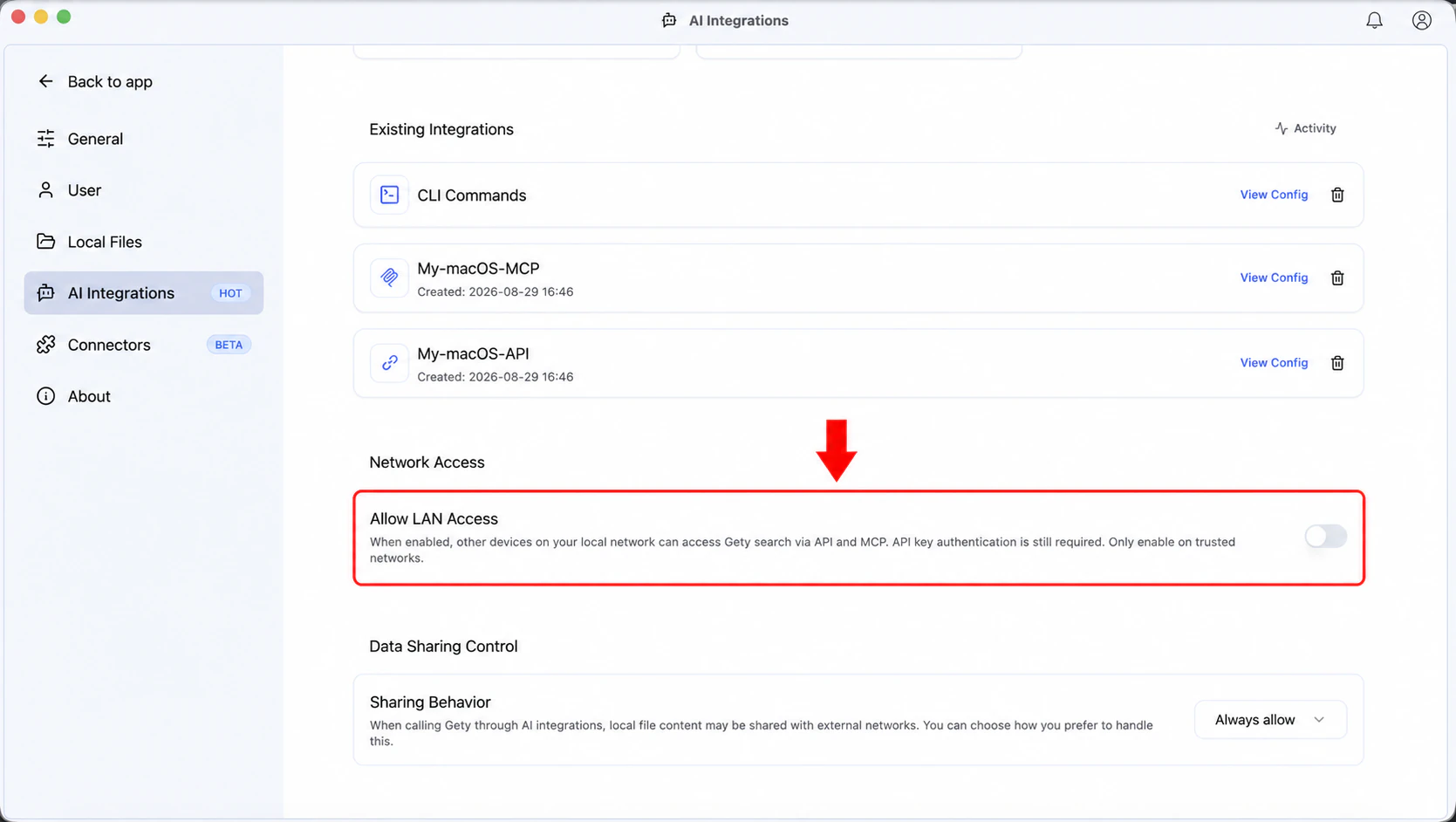
If your devices are not on the same LAN, you can use Tailscale to connect them, then access Gety through its LAN access feature. This requires some network configuration experience.
Troubleshoot problems
For help with search, indexing, or installation errors, see Troubleshooting.